
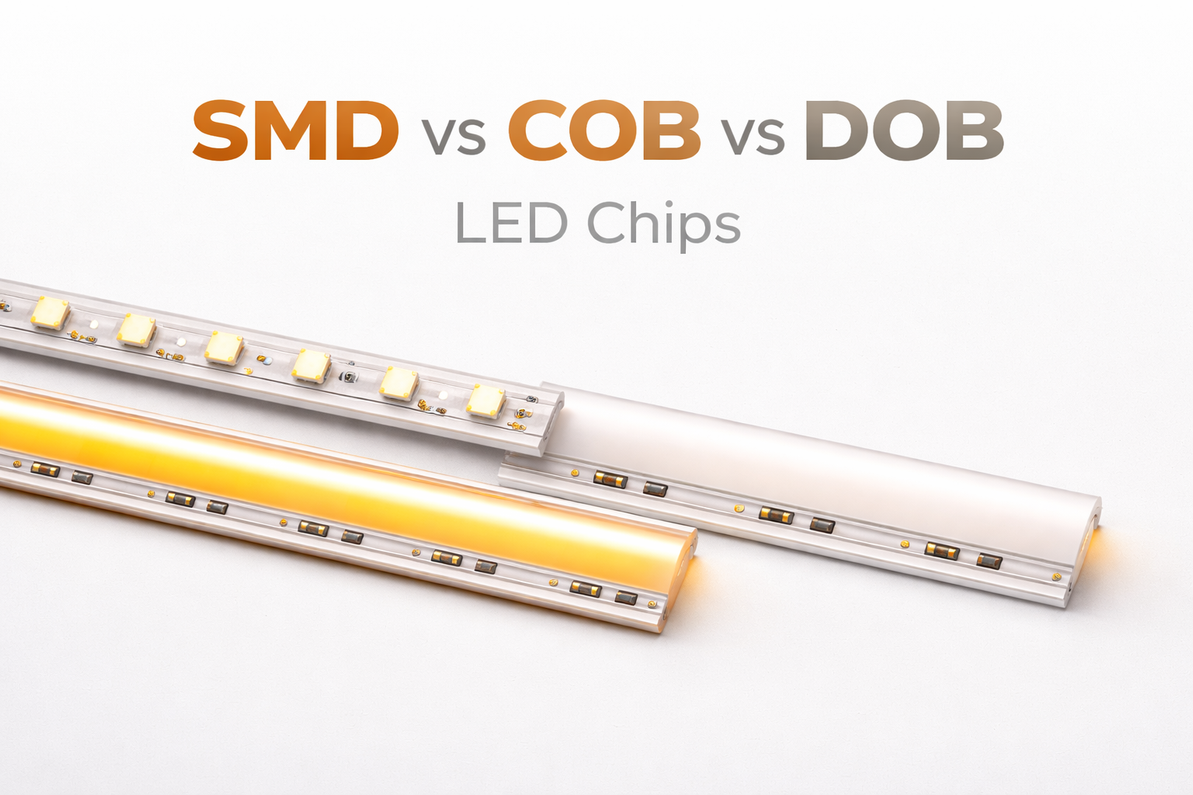
SMD vs COB vs DOB LED Strips | Comparison Guide | Volka Lighting
SMD vs COB vs DOB LED Strips: The Complete Australian Comparison Guide
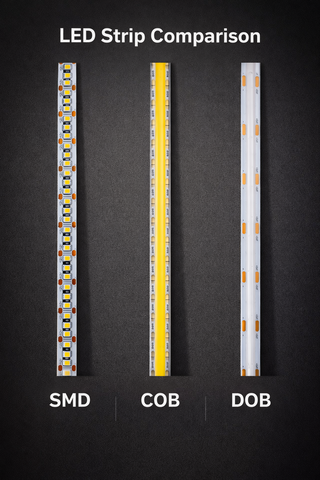
Choosing the right LED strip technology means understanding how the light-emitting diodes are physically mounted to the board, how they are coated, and what that means for the finished look of your installation. Whether you are specifying under-cabinet kitchen lighting, fitting out a commercial retail display, or lighting a residential bulkhead, this guide covers exactly what SMD, COB, and DOB (Smoothline) mean, how they compare, and which one to specify for your project.
Below you will find each technology explained in detail, a full specification comparison table, aluminium profile requirements, driver sizing, dimming options, and a quick buying guide.
Why the Physical Architecture of an LED Strip Matters
Ten years ago, specifying LED strip lighting for a kitchen cabinetry build, bulkhead, or outdoor alfresco was relatively simple. You measured the length, picked a colour temperature, and selected a waterproof rating. Today, the expectations for architectural lighting finishes are significantly higher.
The single biggest factor in how your lighting performs (how smooth the light looks, how hot the strip runs, and how long the installation lasts) is the physical architecture of the LED strip itself. How are the light-emitting diodes mounted to the flexible circuit board, and how are they coated?
The lighting industry loves an acronym. As you research the right lighting for your project, you will frequently encounter three main terms: SMD, COB, and DOB. While they all provide linear light, they represent entirely different fabrication methods, diffusion techniques, and ideal use cases.
Getting this choice wrong usually results in the dreaded "dotted" look reflecting off your gloss black kitchen splashback, or a strip that is too thick to fit inside your custom joinery routing. This guide completely strips back the marketing jargon to examine exactly what each technology is, how they differ in optical performance, and precisely which one you should be specifying for your next residential or commercial project.
SMD Explained: The Versatile Workhorse
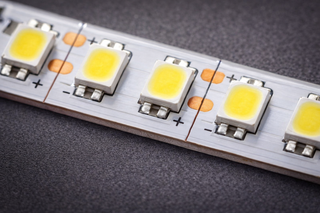
SMD stands for Surface Mounted Device. This is the traditional, fundamentally proven standard of LED strip lighting that has driven the market for the last decade. If you have ever looked at an LED strip and seen individual, distinct yellow squares soldered onto a flexible copper ribbon with physical gaps between them, you are looking at an SMD strip.
How SMD Technology Works
In an SMD strip, individual LED chips are packaged into distinct, tiny plastic or ceramic housings. During assembly, robotic machines pick up these chips and surface-solder them directly onto the Printed Circuit Board (PCB). The chips are spaced at regular intervals, most commonly 60, 120, or up to 240 LEDs per metre for high-density applications.
Because the chips are physically separated and packaged individually, each one acts as a distinct point source of light. In product specification sheets, you will often see SMD chips referred to by a four-digit number, such as 5050, 3528, or 2835. These numbers refer to the physical dimensions of the chip casing in tenths of a millimetre (e.g. a 5050 chip measures exactly 5.0mm by 5.0mm).
The Strengths of SMD
- Colour Availability: Like COB and DOB technologies, SMD strips are widely available in all colour specifications including Single Colour, RGB, RGBW, and CCT colour changing models.
- Unbeatable Cost-Efficiency: The manufacturing process for SMD is highly mature and entirely automated, making it the most affordable linear lighting solution per metre.
- High Output Potential: Modern SMD chips, particularly the 2835 variants, are highly efficient and capable of massive lumen outputs, making them ideal when sheer brightness is the goal over aesthetics.
- Extended Run Lengths: Because of the discrete chip architecture, SMD strips handle voltage much more efficiently over longer distances before suffering from brightness drop-off. You can comfortably run 6 metres on 12V power, and push 12+ metres on 24V power.
The Weakness: The LED Strip Dotting Problem
The primary drawback of standard SMD technology is "spotting" or "dotting." Because there is a physical unlit gap between the diodes, the strip casts distinct points of light rather than a continuous wash. If you mount an SMD strip inside a shallow aluminium profile with a thin diffuser, you will clearly see a dotted line. This is the most common complaint from homeowners who install LED strip lighting under kitchen cabinets without understanding the technology first.
To fix LED strip dots with SMD technology, you must mount it inside a very deep aluminium extrusion with a heavy frosted cover, forcing the light to travel further and blur before escaping. In modern shallow joinery, this simply is not always possible.
When to Specify SMD: SMD is perfect for indirect lighting where the strip assembly itself is completely hidden from view and the light is allowed to wash over a surface before hitting the eye. Specify SMD for deep ceiling bulkheads, drop-ceiling coves, under-bed floating frames, outdoor deck perimeters, and any robust application where you require RGB colour-changing capabilities.
COB Explained: The Dotless Premium Choice
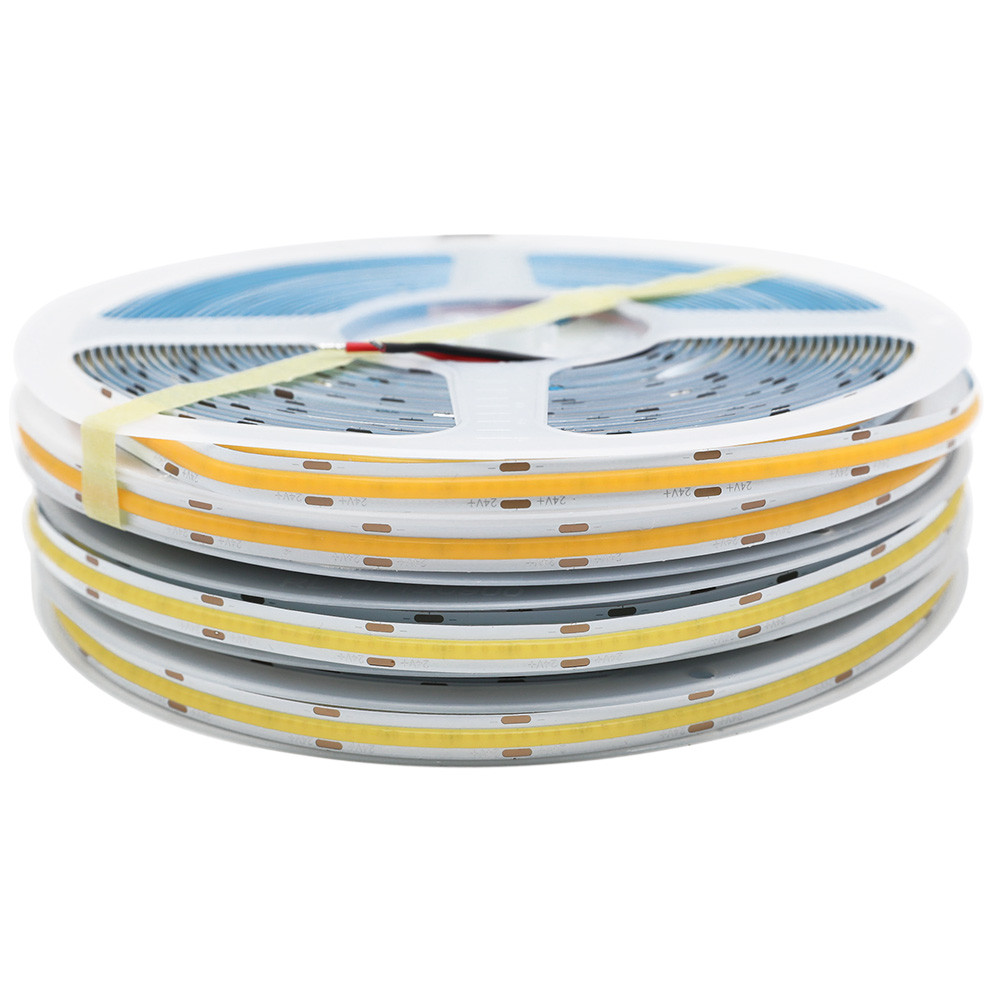
COB stands for Chip On Board. This represents a massive evolutionary leap in linear LED lighting. It was engineered specifically to solve the one major architectural flaw of standard SMD strips: the visible dots. If you are looking for the best LED strip for kitchen cabinets where the light reflects directly off stone benchtops or gloss splashbacks, COB is the answer.
How COB Technology Works
Instead of packaging individual light-emitting diodes into tiny distinct plastic casings, COB technology takes the raw, microscopic crystalline LED chips and mounts them directly, completely bare, onto the printed circuit board. By skipping the individual plastic packaging, manufacturers can pack an incredible number of chips into an exceptionally tight space, often 480, 528, or even up to 840 individual chips per metre.
Once these hundreds of microscopic bare chips are soldered linearly onto the PCB, the entire line is covered in one continuous, poured strip of phosphor-infused silicone. This yellow/orange phosphor layer acts as a built-in, continuous diffuser right at the light source.
The Strengths of COB
- Flawless, Zero-Dot Illumination: This is the headline feature. COB strips look like a solid neon thread of light. Even if you look directly at the bare strip, or if the light reflects intimately close off a mirror or black granite, you will not see individual points of light.
- Fits in the Shallowest Profiles: Because the light is inherently smooth at the origin point, you do not need to rely on deep, bulky aluminium profiles to diffuse the light. COB strips can be mounted in incredibly shallow surface-mount extrusions (as thin as 6mm or 7mm deep) and still deliver a perfectly dotless finish.
- Wider 180-Degree Beam Angle: Traditional SMD chips typically project light at a 120-degree cone. Because the COB phosphor coating is domed and continuous, it casts a wider 180-degree beam angle, washing adjacent vertical surfaces much more effectively.
The Weakness: LED Strip Voltage Drop
The primary trade-off for COB's extreme chip density is power management. COB strips draw a heavier, sustained current that leads to faster light drop-off (voltage drop) over distance compared to SMD and DOB. Typically, a continuous COB run can only travel 3 to 4 metres on a 12V system, or about 7 metres on a 24V system, before the far end visibly dims. Longer continuous architectural runs will require mid-point power injection.
When to Specify COB: COB is the absolute premium choice for direct visual line-of-sight applications and highly reflective environments. Specify COB for under-cabinet kitchen task lighting over stone benchtops, illuminated bathroom mirrors, shallow retail display shelving, and modern minimalist architectural routing.
DOB (Smoothline) Explained: The Next-Generation Dotless Technology

DOB stands for Diffusion On Board. This is actually a newer technology than COB, and it takes a fundamentally different approach to achieving a dotless finish. Rather than overhauling how the chips are physically mounted (like COB does), DOB is an incredibly clever hybrid technology that bridges traditional SMD manufacturing with the seamless aesthetic that COB popularised. At Volka Lighting, you will frequently see DOB technology branded as our SmoothLine series.
How Diffusion On Board Technology Works
A DOB strip begins its life exactly like a high-density standard SMD strip, utilising very small, highly efficient grouped chips (like the SMD 2022 format). However, instead of leaving these chips bare and exposed on the flexible circuit board, the entire top layer of the strip is encased or "poured" over with a carefully formulated layer of silicone diffusion material.
This diffusion layer essentially acts as a mini-frosted cover permanently attached directly to the strip. The light from the underlying SMD chips hits the silicone immediately, scattering the light sideways and upwards long before it ever leaves the physical boundaries of the tape.
The Strengths of DOB / SmoothLine
- Perfect Dotless Finish: DOB strips achieve the exact same flawless, zero-dot diffusion as COB strips. The light blends flawlessly without spotting, providing a premium seamless aesthetic.
- Superior Efficiency and Brightness: As a newer technology than COB, DOB is fundamentally more efficient. It produces a brighter light output while consuming the exact same amount of power, making it the superior choice for high-performance architectural lighting.
- Colour Capabilities: Just like SMD and COB technology, DOB is fully capable of providing Single Colour, RGB, RGBW, and CCT adjustable outputs. The CCT Multi-White Smoothline allows you to tune between warm white and cool white from a single strip.
- Free-Cut Convenience: Advanced DOB lines like the Free Cut Smoothline allow for cutting at incredibly short intervals (or anywhere at all), making it perfect for custom joinery where you need lighting to fit an exact, non-standard millimetre measurement.
- Extended Run Lengths: Because DOB is built on a highly efficient foundation beneath its diffusion layer, it maintains excellent voltage drop resistance, easily outperforming COB. A 12V DOB strip can manage around 5 metres before dropping brightness, while a 24V DOB strip can push an impressive 10+ metres.
When to Specify DOB (Smoothline): DOB is arguably the most versatile dotless technology available today. Specify DOB (Smoothline) for large-scale architectural projects, custom cabinetry, and joinery lines where you require a premium seamless finish combined with CCT colour tuning, precise free-cut points, or extended run lengths that COB simply cannot match.
Side-by-Side Spec Comparison
This table summarises how SMD, DOB (Smoothline), and COB LED strip technologies compare across the specifications that matter most when specifying a project.
| Feature | SMD | DOB (Smoothline) | COB |
|---|---|---|---|
| Dotless Finish | No (needs deep diffuser) | Yes (perfect seamless line) | Yes (perfect seamless line) |
| Max Run Length | Excellent: 6m @ 12V / 12m+ @ 24V | Great: 5m @ 12V / 10m+ @ 24V | Limited: 3-4m @ 12V / ~7m @ 24V |
| Chip Architecture | Point source plastic casing (e.g. 5050) | SMD chips under poured silicone | Bare crystals under phosphor coat |
| Beam Angle | 120 degrees | 120 - 160 degrees | 180 degrees (widest wash) |
| Physical Thickness | Extremely thin (ultra-low profile) | Slightly raised due to diffusion pour | Extremely thin (ultra-low profile) |
| Efficiency & Brightness | High | Highest (max brightness per watt) | Moderate |
| Colour Options | RGB, RGBW, CCT, Single | RGB, RGBW, CCT, Single | RGB, RGBW, CCT, Single |
| Price Range | $ (Most affordable) | $$ (Premium) | $$ (Premium) |
| Best For | Hidden bulkheads, RGB, budget installs | Dotless look with CCT tuning, free-cut, long runs | Shallow profiles, kitchens, gloss surfaces |
Why You Absolutely Must Use Aluminium Profiles for SMD, COB, and DOB
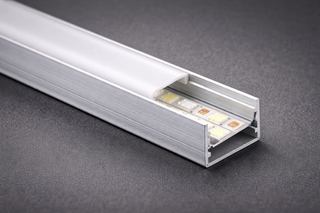
Regardless of whether you spend your budget on ultra-premium COB strips, high-output SMDs, or clever DOB Smoothline tapes, sticking the bare adhesive backing directly to timber, gyprock, or raw plastic is a guaranteed way to ruin your financial investment.
High-quality LEDs generate thermal energy. If that heat cannot escape rapidly from the back of the circuit board, it bakes the delicate diodes and the phosphor coatings. Within 12 to 18 months, an LED strip stuck directly to an MDF cabinet will dim by up to 40%, violently shift in colour temperature, and eventually fail entirely due to thermal stress. A quality strip mounted correctly inside an aluminium profile should deliver 50,000+ hours of consistent output.
This is exactly why Aluminium LED Profiles (also known as mounting channels or extrusions) are non-negotiable for professional lighting.
- Heatsinking: Aluminium is an exceptional thermal conductor. The channel acts as a massive heatsink, aggressively drawing heat away from the chips and dissipating it gracefully into the air. This effectively doubles or triples the lifespan of the strip.
- Physical Protection: The channel and its polycarbonate cover protect the delicate surface circuitry from dust, kitchen grease, insects, and physical impacts (crucial if mounting low to the ground or under kickboards).
- Adhesion: The 3M backing tape on high-quality LED strips is designed to bond permanently to a smooth, clean, non-porous metal surface. It will quickly peel away and droop from porous timber or dusty gyprock plaster walls.
When specifying a job, you do not just buy a strip; you buy the complete system: Strip + Aluminium Profile + Appropriate LED Driver.
Calculating the Right LED Driver Wattage

One of the most common mistakes in LED strip installations is under-sizing (or completely forgetting) the LED driver. The driver is the power supply that converts your 240V mains electricity down to the 12V or 24V DC that the strip requires. Every single LED strip installation needs one, and getting the wattage wrong will cause flickering, dimming, or outright failure.
The Simple Formula
Calculating the correct driver size is straightforward. You need three numbers: the strip's wattage per metre (listed on every product page), the total length of strip you are installing, and a 20% safety buffer to prevent the driver from running at maximum capacity (which generates excess heat and shortens its lifespan).
| Step | Calculation |
|---|---|
| 1. Base Load | Strip wattage per metre × total metres of strip |
| 2. Add 20% Buffer | Base load × 1.2 = minimum driver wattage |
| 3. Select Driver | Choose the next standard driver size above your minimum |
For example, if you are installing 8 metres of a 14.4W/m COB strip, your calculation is: 14.4 × 8 × 1.2 = 138.24W. You would select the next driver size up, which is typically a 150W unit.
Pro tip: For any run longer than 4 metres, we strongly recommend using 24V strips and drivers instead of 12V. The higher voltage dramatically reduces current draw across the strip, which means less voltage drop, less heat generation, and significantly longer maximum run lengths before you need to inject power from a second point. Browse our full range of LED drivers and power supplies to find the right unit for your project.
Dimming Compatibility: What You Need to Know
Almost every quality LED strip is inherently dimmable. The strip itself does not care about brightness levels. However, the method of dimming and the type of controller you use makes a significant difference in performance and flicker-free operation.
PWM Dimming (Recommended)
PWM stands for Pulse Width Modulation. This is the industry-standard method for dimming low-voltage LED strips. A PWM dimmer sits between the driver and the strip, rapidly switching the power on and off thousands of times per second. By adjusting the ratio of on-time to off-time, it controls perceived brightness without changing the voltage. The result is perfectly smooth, flicker-free dimming from 100% down to near-zero. This is the method we recommend for all residential and commercial installations.
TRIAC Dimming (Mains-Side)
TRIAC dimming uses a standard wall-mounted dimmer switch (the kind you would use for a halogen downlight) to control the brightness at the 240V mains side, before the driver. This only works if you pair it with a specifically labelled TRIAC-compatible dimmable LED driver. A standard non-dimmable driver connected to a TRIAC wall dimmer will flicker violently and may be damaged. Always check the driver specifications before purchasing.
0-10V Dimming (Commercial)
This is a professional-grade dimming protocol commonly used in commercial fit-outs and building management systems. A 0-10V signal wire from the control system connects to a compatible driver, providing smooth linear dimming. This is typically overkill for residential projects but is the preferred choice for offices, retail stores, and hospitality environments where the lighting is integrated into a centralised control system.
Pro tip: The golden rule of LED dimming is simple: the dimmer must be compatible with the driver, and the driver must be compatible with the strip voltage. If you are unsure which combination to use for your specific project, contact our technical team and we will spec it for you.
Which Strip Should You Buy?
Use this quick reference to find the right strip technology for your specific project type.
- Kitchen under-cabinet lighting over stone or gloss surfaces: COB strips or DOB Smoothline strips. Both deliver a zero-dot finish in shallow profiles. COB gives the widest 180-degree beam; DOB offers higher brightness per watt.
- Long architectural runs (10m+) needing a dotless finish: DOB Smoothline in 24V. Its superior voltage drop resistance means you can push 10+ metres on a single run without visible dimming at the far end.
- Custom joinery with non-standard millimetre lengths: Free Cut Smoothline. Cut at any point along the strip to fit exact measurements.
- Tunable white (warm to cool from one strip): CCT Multi-White Smoothline. Blend between warm white and cool white on demand.
- Deep ceiling bulkheads, coves, and hidden indirect lighting: SMD 2835 strips. Maximum brightness at the lowest cost per metre, and the dots are invisible when the strip is fully hidden.
- RGB colour-changing feature walls and entertainment areas: SMD 5050 or 3528 RGB strips for budget builds. DOB and COB RGB options are also available for a premium dotless colour-changing finish.
- Every installation: Aluminium LED profiles and an appropriately sized LED driver. These are non-negotiable.
LED Strip Technology FAQ
What is the difference between COB and SMD LED strips?
COB (Chip On Board) LED strips have hundreds of bare tiny chips mounted tightly together under a continuous phosphor silicone line, creating a uniform, completely dotless line of light. SMD (Surface Mounted Device) strips consist of individual LED chips physically spaced apart on the board, which are highly versatile and cost-effective but will produce distinct, visible dots if not hidden or deeply diffused inside an aluminium profile.
What does DOB mean in LED strip lighting?
DOB stands for Diffusion On Board. Often branded as Smoothline, DOB is actually a newer technology than COB. While both provide a perfect, smooth dot-free finish, DOB is superior in efficiency. It provides a brighter output using the exact same amount of power, and handles voltage drop significantly better, allowing for much longer maximum run lengths. DOB and COB are priced comparably in the premium tier.
Where should I use COB LED strips instead of SMD?
COB LED strips are the premium choice in locations where a flawless line of light is required but physically deep extrusions are not possible. Specify COB for under-cabinet kitchen task lighting, ultra-shallow aluminium mounting profiles, or areas where the strip's light reflection will be highly visible on glossy surfaces like polished stone benchtops, glass splashbacks, or mirrors.
Do I absolutely need to mount LED strips in an aluminium profile?
Yes. Aluminium profiles act as a critical thermal heatsink. If an LED strip is stuck directly to timber or plasterboard, it cannot dissipate heat effectively, causing the diodes to dim significantly and fail rapidly. The metal profile also protects the delicate strip from physical damage and provides a smooth surface for the permanent 3M adhesive backing to bond correctly.
How do I calculate the correct LED driver wattage?
Multiply the strip's wattage per metre by the total length of strip you are installing, then multiply by 1.2 to add a 20% safety buffer. For example, 8 metres of a 14.4W/m strip requires: 14.4 x 8 x 1.2 = 138.24W minimum. Always select the next driver size up from your calculation. Use a power supply calculator to confirm.
Can LED strips be dimmed?
Yes, virtually all quality LED strips are dimmable. The recommended method is PWM (Pulse Width Modulation) dimming, where a controller sits between the driver and strip. Alternatively, TRIAC dimming uses a standard wall dimmer but requires a specifically labelled TRIAC-compatible dimmable LED driver. Always ensure your dimmer is compatible with your driver before purchasing.
Need Help? Get a Free Custom Lighting Plan
If your project is complex or you want an expert to check your specifications, the Volka team offers full custom LED lighting solutions. Send your measurements and goals, and receive a free quote with the right products specced for your job.
Browse the Custom LED Solutions page for completed residential and commercial projects. When you are ready, fill out the project request form for a proper spec and price. For general questions, reach out through the contact page.
About the Author
This guide was written by the Volka Lighting technical team, with over 15 years of experience designing and supplying LED strip lighting systems and aluminium LED profiles across Australia. The recommendations reflect practical knowledge gained from real residential and commercial lighting installations.
Recent Posts
-
Backlit Marble & Onyx LED Guide | Volka Lighting Australia
How to Backlight Marble & Onyx: The Complete LED Stone Lighting Guide (Australia) TL;DR: To backligh …15th May 2026 -
Why LED Strips Are Perfect for Cabinet Lighting | Volka
Why LED Strips Are Perfect for Cabinet Lighting TL;DR: LED strips are the ideal cabinet lighting sol …10th Apr 2026 -
SMD vs COB vs DOB LED Strips | Comparison Guide | Volka Lighting
SMD vs COB vs DOB LED Strips: The Complete Australian Comparison Guide TL;DR: Need a flawless, conti …19th Mar 2026